
Openers
Chain drive, belt drive, or wall mount: how to actually choose
Most opener advice is a spec sheet. What actually matters is whether there is a bedroom over your garage, how heavy your door is, and whether you want your ceiling back.
Arizona heat and desert dust wear garage door springs out faster than their rated cycle life. What causes it, and how to get more years from the next set.
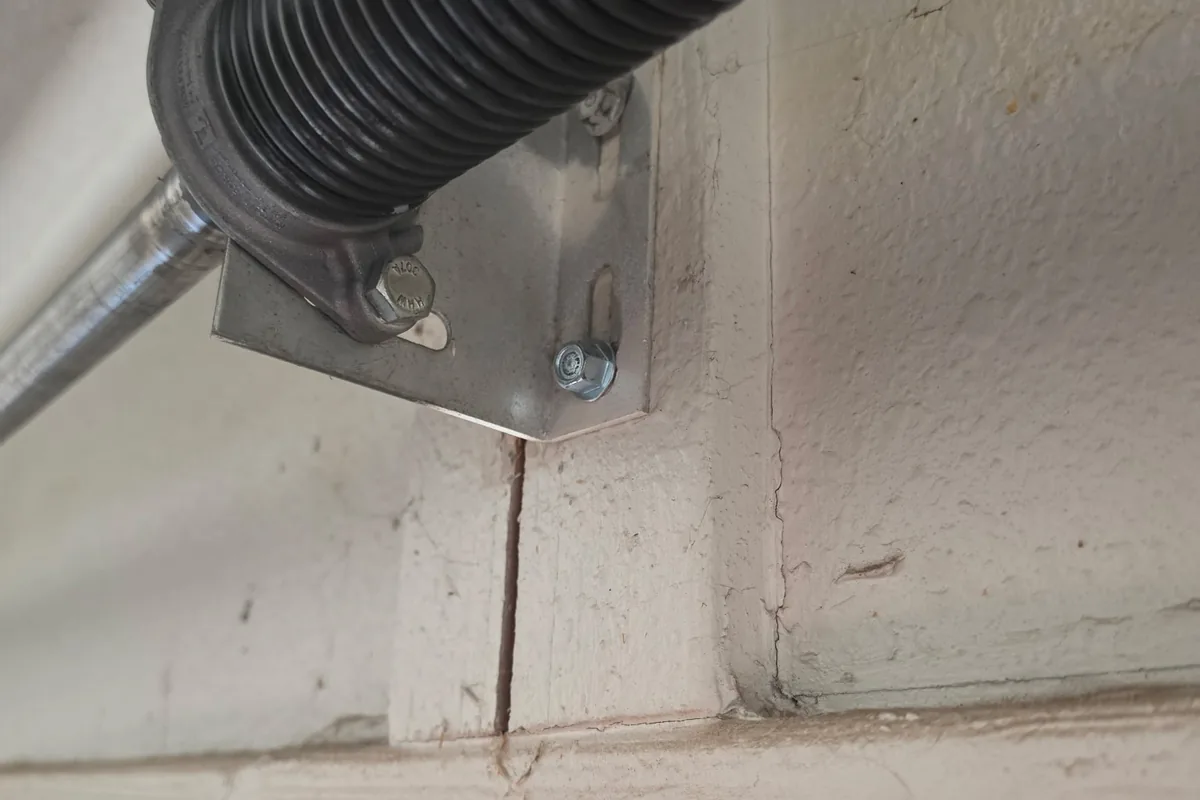
Almost every homeowner who calls us about a spring says the same thing: it happened with no warning. There was a bang loud enough to be mistaken for a gunshot, and then the door would not move. It feels sudden, but a spring that snaps on a Tuesday morning has usually been wearing out for years. Understanding what wears them down is the difference between replacing springs on your own schedule and replacing them the morning your car is trapped inside.
A cycle is one full open and close. That is the unit springs are engineered around, and a standard residential torsion spring is rated for roughly 10,000 of them. Nothing about that number refers to time, which is why two identical doors can be five years apart in spring life.
Most households open the garage three to five times a day once you count everyone leaving, coming back, and the occasional trip for the trash cans. That works out to somewhere between about 1,100 and 1,825 cycles a year. Do the division and a standard spring lands somewhere in the five to seven year range for a busy family, and closer to nine years for a quieter household.
| Spring type | Cycle rating | Rough lifespan at 4–5 uses a day |
|---|---|---|
| Standard torsion spring | 10,000 cycles | 5–7 years |
| High-cycle torsion spring | 25,000 cycles | 14–17 years |
| Extension spring (side-mounted) | 10,000 cycles | 5–7 years, often shorter |
Those figures are the industry-standard ratings, and they assume a reasonable climate. Arizona is not a reasonable climate.
A garage in the Valley regularly sits at 110 to 115 degrees in July, then drops toward freezing on a January night. Even day to day, a 30 to 40 degree swing between afternoon and early morning is completely normal here. Steel expands and contracts through every one of those swings, and that repeated movement causes microscopic fatigue in the wire on top of the fatigue from the door's own weight. The practical result is that a spring rated for 10,000 cycles in a mild climate can give up meaningfully sooner in the East Valley.
This is the part people never expect. Fine dust settles onto the spring coils and sits between them. Every time the spring winds and unwinds, that grit grinds against the steel. On a spring that has never been lubricated, this alone can take a noticeable bite out of its working life — the figures cited across the industry run in the range of 20 to 30 percent.
Phoenix is dry, so homeowners assume rust is a coastal problem. But a spring that has never seen lubricant develops surface corrosion anyway, and each rust pit is a stress concentration — a small place where a crack can start. Springs almost always break at a point like that rather than in the middle of clean steel.
Springs rarely fail in complete silence. They usually announce themselves for weeks first, in ways that are easy to dismiss as the door just getting older.
That visible gap is the most reliable single indicator. Torsion springs sit horizontally on a shaft above the door opening, and a broken one separates cleanly. If you can stand inside the garage, look up, and see a break in the coil, you have your answer and you do not need anyone to diagnose it for you.
If you want to know how your springs are doing before anything breaks, there is one check that is safe for a homeowner and genuinely informative.
A correctly balanced door stays roughly where you left it. If it drops, the springs no longer have enough tension to hold the weight. If it shoots upward, there is too much. A properly balanced door should feel like lifting ten pounds or less, no matter how heavy the door actually is — that is the entire job the springs do.
If your door has two springs and one breaks, the other one has been through exactly the same number of cycles. It is not a spare in good condition, it is a spring at the end of the same working life. Replacing only the failed one typically buys you weeks or months before the second goes, and then you pay for another visit and another round of labor to do the half of the job you skipped.
Doing both at once also keeps the door balanced properly, which matters for the opener. An unbalanced door makes the motor work harder every single cycle for the rest of its life. This is one of the few cases where the more expensive option on the day is genuinely cheaper over time, and we will tell you when it applies to your door and when it does not.