
Springs
Why garage door springs break sooner in Arizona
A standard torsion spring is rated for about 10,000 open-and-close cycles. In the East Valley, heat swings and dust mean you often do not get all of them. Here is why, and what to do about it.
Grinding, squealing, banging, rattling, or popping as the door moves. What each garage door noise usually means, and which ones need attention right now.
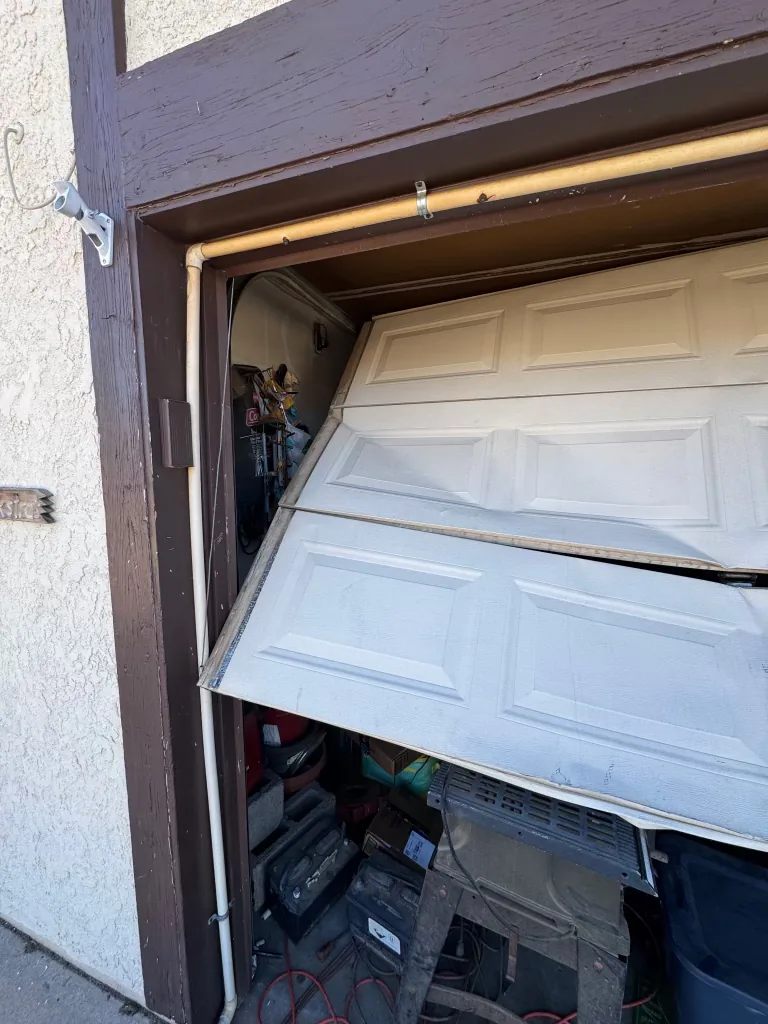
A garage door is the largest moving object in most homes, and like anything mechanical it changes its sound before it changes its behaviour. Learning to read those sounds is genuinely useful, because the gap between a cheap part and a major repair is often just how long the noise got ignored.
This is a broken spring, and it is the one entry on this list that is close to a certainty. People describe it as a gunshot, a firecracker, or something heavy falling off a shelf. What you heard was the stored tension in a torsion spring releasing all at once.
Nine times out of ten this is friction, and friction usually means dry rollers, dry hinges, or dry springs. In the East Valley there is a second ingredient: dust in the roller bearings, which turns a lubrication problem into an abrasion problem.
This is worth trying yourself before calling anyone. A can of silicone-based garage door lubricant on the rollers, hinges, and spring coils resolves a surprising share of squealing doors. Skip the heavy grease, which collects the dust you are trying to get rid of. If it still squeals after a proper lubrication, the roller bearings are likely worn out rather than dry.
Grinding is a different character of sound and it usually means metal contacting metal where it should not be. The common causes are worn rollers that are no longer rolling but dragging, a bent or misaligned track, or debris in the track. Inside the opener itself, grinding often points at the drive gear, which is a plastic part that wears and is a normal repair rather than a reason to replace the whole unit.
Rattling is usually the least urgent noise on this list and often the easiest to fix. Garage doors move constantly, and the nuts and bolts holding the hinges, brackets, and track supports work loose over years of cycling. Tightening the hardware and the track mounting bolts frequently quiets a door down noticeably. If the rattle is coming from the opener rail rather than the door, that is worth having looked at rather than tightened blindly.
Popping as the door moves through its travel is often the sections flexing against worn hinges, or rollers binding as they pass a joint in the track. It can also indicate the door is out of alignment and fighting itself slightly on every cycle. This one is worth having someone look at, because the underlying misalignment is what eventually pulls a door off its track.
If the motor runs and the door does not move at all, the two usual explanations are a broken spring (see the bang above) or a stripped drive gear inside the opener. There is a third and much happier possibility: the emergency release cord has been pulled, disconnecting the opener from the door. Check that before anything else, because reconnecting the trolley costs nothing.
| Sound | Likely cause | How urgent |
|---|---|---|
| Loud bang, door dead | Broken spring | Stop using the door now |
| Grinding | Worn rollers, bent track, opener gear | Soon — it gets worse and takes other parts with it |
| Popping while travelling | Worn hinges or misalignment | Have it looked at |
| Squealing | Dry or dusty rollers, hinges, springs | Try lubricating first |
| Rattling | Loose hardware | Low — tighten it |
Two of the five entries in that table are things you can reasonably handle yourself with a can of silicone spray and a socket wrench. We would rather tell you that than sell you a service call you did not need.