
Springs
Why garage door springs break sooner in Arizona
A standard torsion spring is rated for about 10,000 open-and-close cycles. In the East Valley, heat swings and dust mean you often do not get all of them. Here is why, and what to do about it.
The difference between chain drive, belt drive, and wall-mount jackshaft garage door openers, and which one is genuinely worth paying for depending on your garage layout.
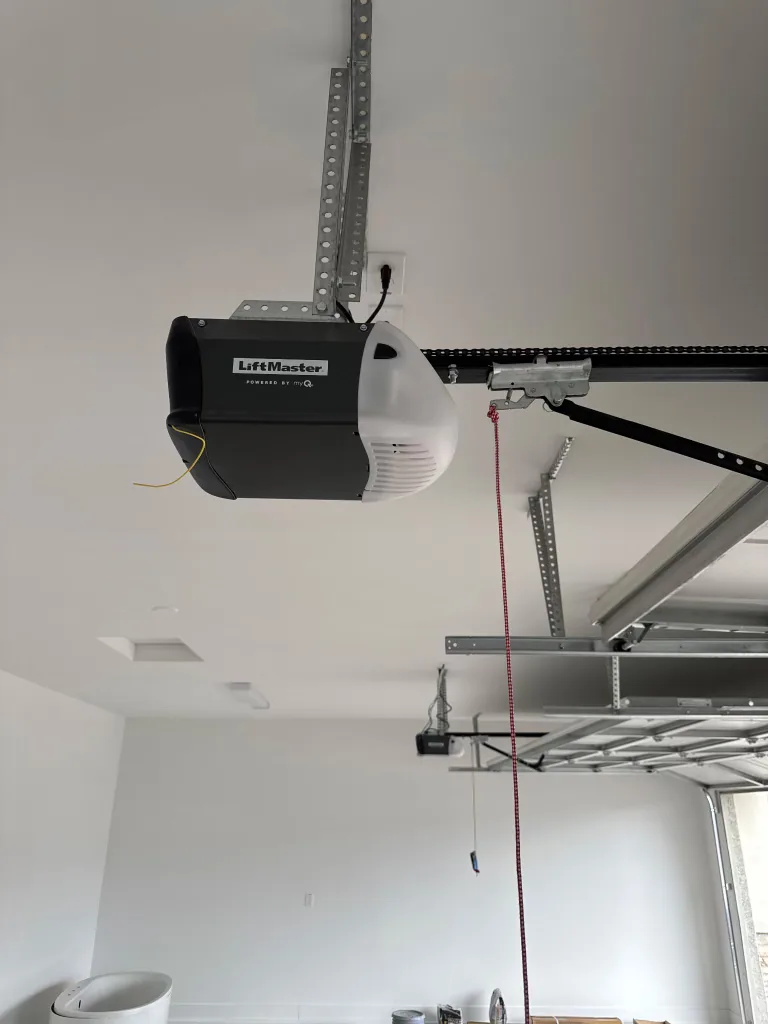
There are three ways a garage door opener can move a door, and the differences between them are not subtle once you live with them. The mistake most people make is choosing on horsepower, which is rarely the deciding factor for a residential door. What actually determines whether you are happy with an opener is where it sits, how much noise it transmits into the house, and how heavy the door it has to move is.
A chain drive uses a metal chain, essentially like a bicycle chain, to pull the door along a rail. It is the oldest of the three designs and the most mechanically straightforward, which is exactly why it is still around.
Chains are strong and handle weight well, so a chain drive is a sensible choice on a heavy door — a solid wood door, or a large double-wide that weighs considerably more than a standard steel sectional. The trade-off is noise and feel. Chain drives are louder, and the movement is a little slower and choppier than a belt. In a detached garage, or one with nothing but roof above it, that noise is a non-issue and you are getting real durability for less money.
A belt drive replaces the chain with a reinforced belt, usually rubber with steel banding through it. Mechanically it does the same job, but the belt does not have the metal-on-metal contact a chain does, so it is dramatically quieter and the travel is smoother.
There is one situation where this stops being a preference and becomes the obvious answer: a bedroom, office, or living space directly above or beside the garage. A chain drive at 6:15 in the morning carries through the floor. A belt drive largely does not. The smoother motion also puts less shock load on the motor and on the door hardware, which tends to show up as fewer nuisance problems over the years.
A wall-mount opener does not sit on the ceiling at all. It mounts on the wall beside the door and drives the torsion shaft directly, which means the entire rail assembly down the middle of your garage disappears.
That is the whole reason people buy them, and it is a better reason than it sounds. If you have a car lift, overhead storage racks, a tall truck or van, a lifted vehicle, or a garage with low headroom or unusual framing, a wall mount solves a problem the other two cannot. It is the most expensive of the three, and on an ordinary garage with plenty of ceiling clearance it is a luxury rather than a necessity. But when the ceiling matters, nothing else will do.
Battery backup is worth more than most people expect in Arizona. Monsoon season takes power out, and an opener without backup means a door you have to wrestle by hand in the heat. Modern openers also include Wi-Fi so you can check from your phone whether you left the door open, which sounds like a gimmick until the first time it saves you a trip home.
The photo-eye safety sensors near the floor are not optional and are not an upsell — they are what makes the door reverse instead of closing on something. If yours are misaligned and you have been holding the wall button to force the door closed, that is a genuine safety problem worth fixing regardless of what opener you have.